EMT Practice Test

1. Question Content...


Question List

Question1: Even though past audits have highlighted a consistently large number of nonconformities within an organisation's design team, the organisation has not varied the frequency or duration of audits on its audit plan.
The decision for whether this situation is acceptable or not should be governed by which of the following?

Question2: Which one of the following is not an ISO 9000:2015 quality management principle?

Question3: You, as auditor, are in dialogue with the quality lead and managing director of a small business that supplies specialist laboratory equipment and furniture.
You: "I'd like to look at how you manage change in the organisation. What changes have you made as a business, say, over the last 12 months?" Auditee: "We have made some strategic changes, the main one being that we no longer manufacture our own products in house." You: "That sounds like quite a significant change. What has been the impact of that?" Auditee: "We now mainly sell other manufacturers' products, under their brand names, and have outsourced manufacture of our own brand products to one of our suppliers. Unfortunately, we had to make six members of our staff redundant. This represents about 20% of our workforce, so this has been quite a challenging time." You: "I'm sure. What were the reasons for making the change?" Auditee: "Our manufacturing section was a small operation, and we struggled to cope with fluctuations in demand. During busy periods, we found it hard to meet lead times, and in quiet periods we had staff with little to do. This was having an impact on customer satisfaction and meant we had to charge premium prices that made our product uncompetitive." You: "How did you go about the change?" The auditor asks to speak to the purchasing manager about the selection of the subcontractor to manufacture the company's own brand products.
You: "How did you choose a supplier to manufacture your products?"
Auditee: "We have had a long-term relationship with a supplier ABC Ltd - we gave them our design drawings, got them to complete a supplier questionnaire and run a couple of trial batches for us. We were happy with the result and we have used them ever since." ISO 9001:2015, clause 8.4.1 outlines situations when controls need to be applied to externally provided processes, products and services. Which one of the following situations is applicable to this scenario?

Question4: Which one of the following documents addresses audit time calculation for third-party certification audits?

Question5: The following are stages of an audit, put them in the order they would be conducted.

Question6: Select the phrase that best describes the purpose of a quality management system to ISO 9001 in relation to the performance of an organization.

Question7: You are conducting an audit at an organisation seeking certification to ISO 9001 for the first time. The organisation offers health and safety training to customers. Training courses are offered either as open courses, delivered at a public venue, or online, or as courses that are tailored to meet specific requirements.
The business operates from a single office and those who deliver the training are either full-time employees or subcontractors.
You have gathered audit evidence as outlined below. Match the ISO 9001 Clause 8 extract to the audit evidence.

Question8: You will lead a third-party audit next Monday on ABC, an organisation that provides services for cleaning windows from the outside of tall buildings. They work on demand, and usually have 4-5 orders per week. All documented information on these activities is kept at the central office.
On Friday evening, before the audit, you are informed by mail that customers cancelled all orders for the next week; therefore, the auditors will not have the chance to see them working at the customer's premises, but the field supervisors will be available at the ABC offices.
You have prepared the audit plan and the checklist. Choose the best action you would take:

Question9: Who would be defined as a witness during a witness audit?
Choose two of the following options:

Question10: You are carrying out an audit at a single-site organisation seeking certification to ISO 9001 for the first time.
The organization manufactures cosmetics for major retailers.
You are interviewing the Manufacturing Manager (MM).
You: "I would like to begin by looking at the cleaning controls."
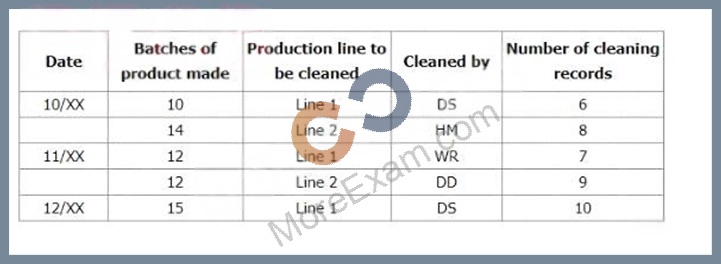
MM: "We record the cleaning of the equipment at the end of every batch. This document details the minimum cleaning frequency and the procedures to follow for all areas and each item of equipment. The person who carries out the cleaning puts their initial on the document and records the time and date alongside." Narrative: You sample production records over 3-days and note down evidence of nonconformity as per the table below.

Question11: A small deaning services organisation is about to start work on a hospital dleaning contract for the local Health Trust. You, as auditor, are conducting a Stage 2 audit to ISO 9001 and review the contract with the Service Manager. The contract requires that a cleaning plan is produced. You: "How was the cleaning plan for the contract developed?" Service Manager: "We have a basic template that covers the materials, labour requirements and cleaning methods to be employed. Some of that is specified by the customer." You: "How does the plan deal with locations like the intensive care wards and the operating theatres, which are included in the contract?" Service Manager: "The basic plan covers general wards, but we will do more frequent cleaning in those areas if the hospital requests it." You: "Are you aware of the regulatory requirements for cleaning standards in hospitals?" Service Manager: "No. We depend on the hospital to look after that side of things in the contract." You decide to raise a non-conformity against section 8.2.2.a.1 of ISO 9001. You decide to raise another non-conformity against section 8.2.4 of ISO 9001 when finding that the cleaning plan was amended without the agreement of the Health Trust. A different cleaning chemical was substituted to that specified in the contract. At the follow- up audit, the corrective action proposed was to "obtain a concession from the Health Trust for use of the new chemical." Which one of the following options is the reason why you did not accept this action taken?

Question12: Which one of the following options best describes the purpose of a Stage 1 third-party audit?

Question13: The Closing meeting of a second-party audit was planned for 6 pm with the general manager and the quality manager.
At 6 pm, when the audit team enters the meeting room, only the Quality Manager is present and walting for them.
The dialogue among them is as follows:
Auditor team leader: "Good evening, could you please inform the general manager that we are ready to start with the closing meeting?" Quality manager: "Good evening. I am sorry to inform you that the general manager will not be able to attend the meeting. He will try to participate virtually to make some closing remarks." Auditor team leader: "OK. We identified seven nonconformities - these are the reports. Could you please review them and sign them?" Quality manager: "OK. As you know, I reviewed them after yesterday's meeting and accept of all them, where shall I sign?" General manager (from speakers in the room and addressing the quality manager): "Hold on! Do not sign the two nonconformities related to ABC Bank! I have just checked, and we did not provide any services to ABC Bank during September! You can sign the remaining five nonconformities." How would you proceed with the audit? Select one.

Question14: ABC is a fast food shop that receives orders by phone or the internet. The normal menu includes 15 different types of hamburgers; however, in the last two days, due to a shortage of a special type of meat, they can only prepare six of the 15 varieties.
You are performing a third-party audit of ABC; you observed that the menu offering food on the website is still the normal one, with 15 different hamburgers. During a 30-minute period, you observed several customers reluctantly accepting other than the hamburger they preferred. You decided to raise the following nonconformity as follows:
"There is evidence that ABC has not reviewed the ability to provide customers the offered products".
The restaurant manager does not accept the nonconformity. She says that ABC had an extensive training programme for all personnel, which you have already seen when auditing Human Resources. This shortage of some hamburgers cannot be considered a management system failure.
Which one would be your answer from the following options?

Question15: An audit team leader arrives at a printing organisation to carry out a Stage 2 audit for a certification body. At a meeting with the Quality Manager, she is told that they have won their biggest contract from a computer manufacturer to print and compile computer documentation packages. They have leased the unit next door for space reasons but have never worked in this sector before. The Quality Manager wants the ISO 9001 certificate to cover the new contract.
During the audit, a team member finds that a number of print jobs have been rejected by several clients over a number of months due to spelling errors in the print run. The Print Manager blames the new employees they had to take on because of a big contract. The auditor raises a nonconformance against clause 10.2.1.b of ISO
9001.
Which one of the evidence statements would support this finding?

Question16: You are leading a Stage 2 certification audit of a multi-site organisation and have received the audit schedule below; Head Office and Site 1 - Day 1 Site 2 (150 Km from HQ) - Days 2 and 3 During Day 1 of the audit, the dient informs you that the laboratory at Site 2 has been dosed for decontamination due to a serious outbreak of an infectious disease among workers. In Site 2, all other functions could be audited as planned.
As the audit team leader, what would you do?
Choose the best acceptable action you could take:
Ask the audit Programme Manager for direction.
Complete the audit on day 3 and report back to the certification body for a certification decision.
Continue the audit on days 2 and 3 and return later to audit the Site 2 laboratory.
Immediately cancel the audit since the audit plan cannot be completed.
Who has the responsibility for assigning work to the audit team?

Question17: Below are four of the seven principles on which ISO 9000 series are based. Match a potential benefit to each of the quality management principles (QMP).

Question18: At the end of a second-party audit, the audit team enters the meeting room to hold the closing meeting; only two people are present and waiting for them: the Health and Safety supervisor and the Administrative Officer.
Neither has participated in the audit. However, the team had previously agreed with the auditee Quality Manager on two nonconformities identified during the audit (NC1 and NC2).
They said:
Health and Safety Supervisor: "Good evening. We are sorry to inform you that the general manager was involved in a serious car accident, and the other two managers have had to leave urgently to attend to the emergency." The Administration Officer: "Concerning 'nonconformity 2', the General Manager left a message asking us to tell you that he does not accept it and requests you not to include it in the audit report. Here is a note in which he explains why." Which one of the following would be your preferred answer (as team leader) to the General Manager's request?

Question19: Select the word that best completes the sentence:
Question20: You work for an organisation, 'A', which provides packaged food to the public. You are asked to lead a team (you as the leader and two other auditors) to audit a supplier, 'B', which provides packaging materials to your organisation. It is 4 p.m. and the audit is close to an end; you are having an internal meeting with the team to decide what will be presented to the auditee during the Closing meeting.
The Closing meeting was scheduled
for 5 p.m.
You, as audit team leader, audited top management, the laboratory, and the storage of raw materials.
Auditor 1 audited the two manufacturing lines and dispatch areas.
You to Auditor 1: "What findings would you report?"
Auditor 1: "When reviewing the Dispatch records, I noticed that during the morning two different trucks (Number 011 and 025) delivered the same batch number of the product (Batch 33555). Truck 011 left the plant at 9.15 am and Truck 025 left the plant at
11.30 am. Procedure P-02 Rev.3 says
that trucks should carry a complete batch. The batch number, once on the truck, is captured using a QR device." You: "OK, what do you think?" Auditor 2: "I think that this is a nonconformity." You: "OK. How would you describe the evidence on which the nonconformity will be based"?
Identify which one of the following statements best describes the identified nonconformity.

Question21: You are carrying out an audit at a single-site organisation seeking certification to ISO 9001 for the first time.
The organization manufactures cosmetics for major retailers and the name of the retailer supplied appears on the product packaging. Sales turnover has increased significantly over the past five years.
You are interviewing the new Product Development Manager. You note that a software application called SWIFT is used to help control the product development process.
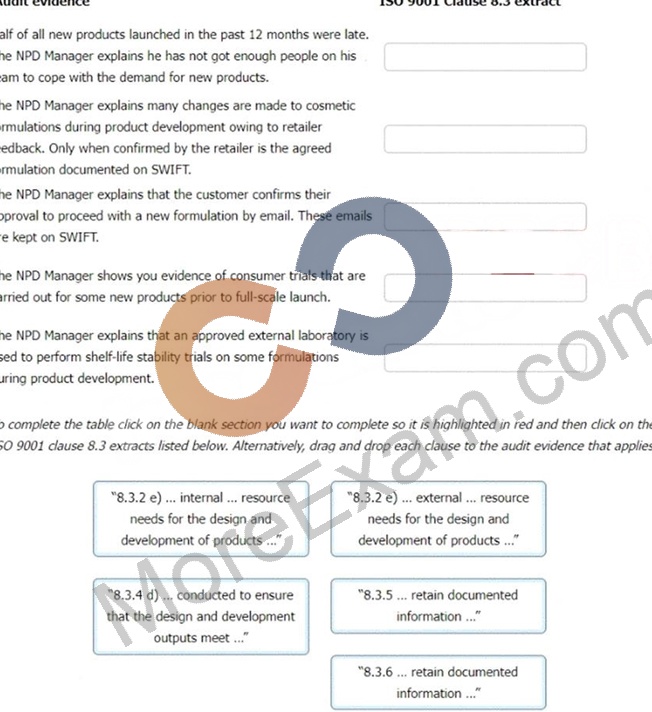
You have gathered audit evidence as outlined in the table. Match the ISO 9001 clause 8.3 extracts to the audit evidence.

Question22: You are carrying out an audit at a single-site organisation seeking certification to ISO 9001 for the first time.
The organisation manufactures
cosmetics for major retailers.
You are interviewing the Manufacturing Manager (MM).
You: "I would like to begin by looking at the cleaning controls."
MM: "We record the cleaning of the equipment at the end of every batch. This document details the minimum cleaning frequency and the procedures to follow for all areas and each item of equipment. The person who carries out the cleaning puts their initial on the document and records the time and date alongside." Narrative: You sample production records over 3-days and note down evidence of nonconformity as per the table below.

Question23: Select the term which best describes the quality management system process of modifying a non-conforming product to bring it within acceptance criteria.

Question24: Which of the following three options could be considered potential threats to impartiality in an audit context?

Question25: You work as an external quality consultant for an organisation, 'A', which provides packaged food to the public. You are asked to lead a team (you as the leader and two other auditors) to audit a supplier, 'B', to ISO
9001 which provides packaging materials to your organisation. It is 4 pm and the audit is close to an end; you are having an internal meeting with the team to decide what will be presented to the auditee during the Closing meeting. The Closing meeting was scheduled at 5 pm.
You, as Audit Team Leader, audited top management. You explain to the audit team that you identified two nonconformities:
a. There is no documented information on Top Management Reviews, as required in clause 9.3 of ISO 9001:
2015.
b. There is no evidence of Top Management Commitment as required in clause 5.1 of ISO 9001:2015. (e.g., not ensuring the availability of resources to operate the QMS, not ensuring the establishment of objectives, no promotion of improvement, no promotion of the process approach).
All agreed to present these two nonconformities. They went to meet the Top Management of 'B' and noticed that the General Manager and three other managers (Production, Human Resources, and Sales) were present in the meeting room.
Considering the seriousness of the two nonconformities to Top Management, as audit team leader, from the following select the best option:

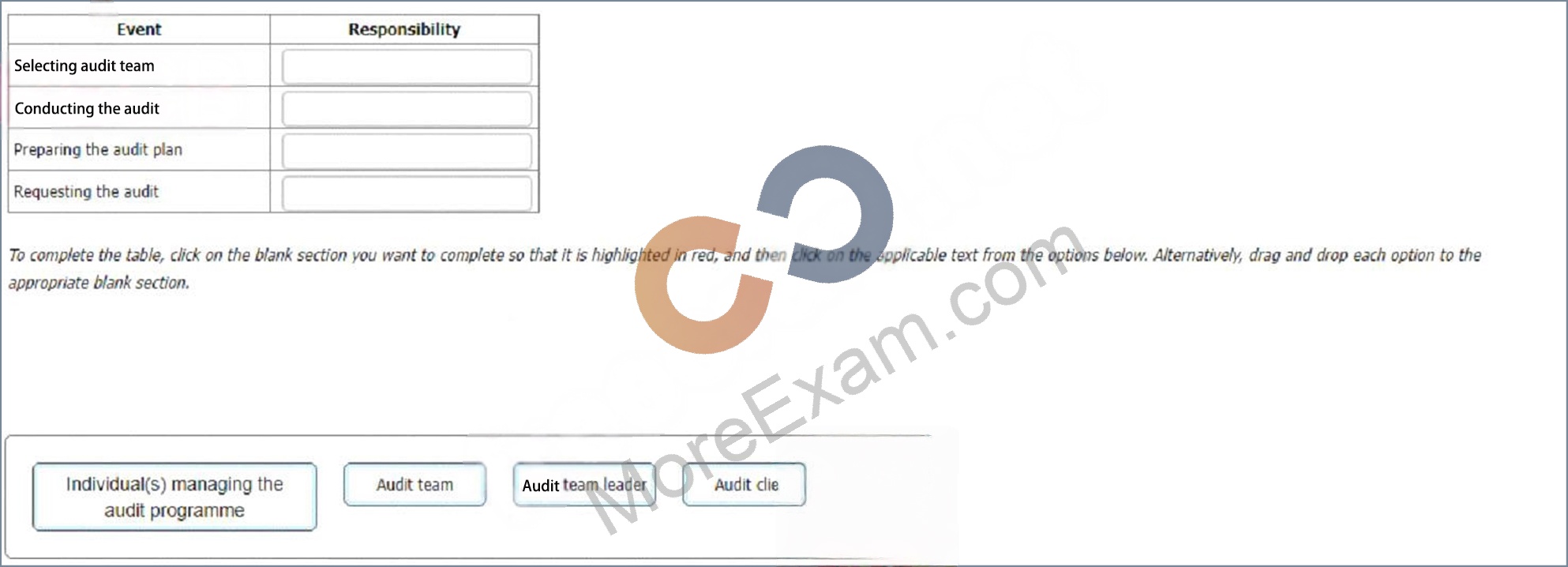
Question26: In the context of a third-party audit, match the event with the responsibility for conducting it.

Question27: An audit team of three people is conducting a Stage 2 audit to ISO 9001 of an engineering organisation that manufactures sacrificial anodes for the oll and gas industry in marine environments. These are aluminium products designed to prevent corrosion of submerged steel structures. You, as one of the auditors, find that the organisation has shipped anodes for Project DK in the Gulf of Mexico before the galvanic efficiency test results for the anodes have been fully analysed and reported as required by the customer. The Quality Manager explains that the Managing Director authorised release of the anodes to avoid late delivery as penalties would be imposed. The customer was not informed since the tests very rarely fall below the required efficiency. You raise a nonconformity against clause 8.6 of ISO 9001.
Which of the following options for the best description of the nonconformity?

Question28: Whistlekleen is a national dry cleaning and laundry company with 50 shops. You are conducting a surveillance audit of the Head Office and are sampling customer complaints. You find that 80% of complaints originate from five shops in the same region. Most of these complaints relate to damage to customer laundry.
The Quality Manager tells you that these are the oldest shops in the company. The cleaning equipment needs replacing but the company cannot afford it at the moment. You learn that the shop managers were told to dismiss most of the claims on the basis of the poor quality of the laundered materials.
On raising the matter with senior management, you are told that there are plans to replace the equipment in these shops over the next five years.
When reviewing the customer complaint file, you find that the organisation is facing a legal dispute with a customer over damage to an expensive cashmere coat.
Select the best option for how this should be handled by the Quality Management System.

Question29: Select one option that must be considered when determining the scope of a QMS to ISO 9001.

Question30: For a third-party, match the Activity with the Responsibility for conducting it.
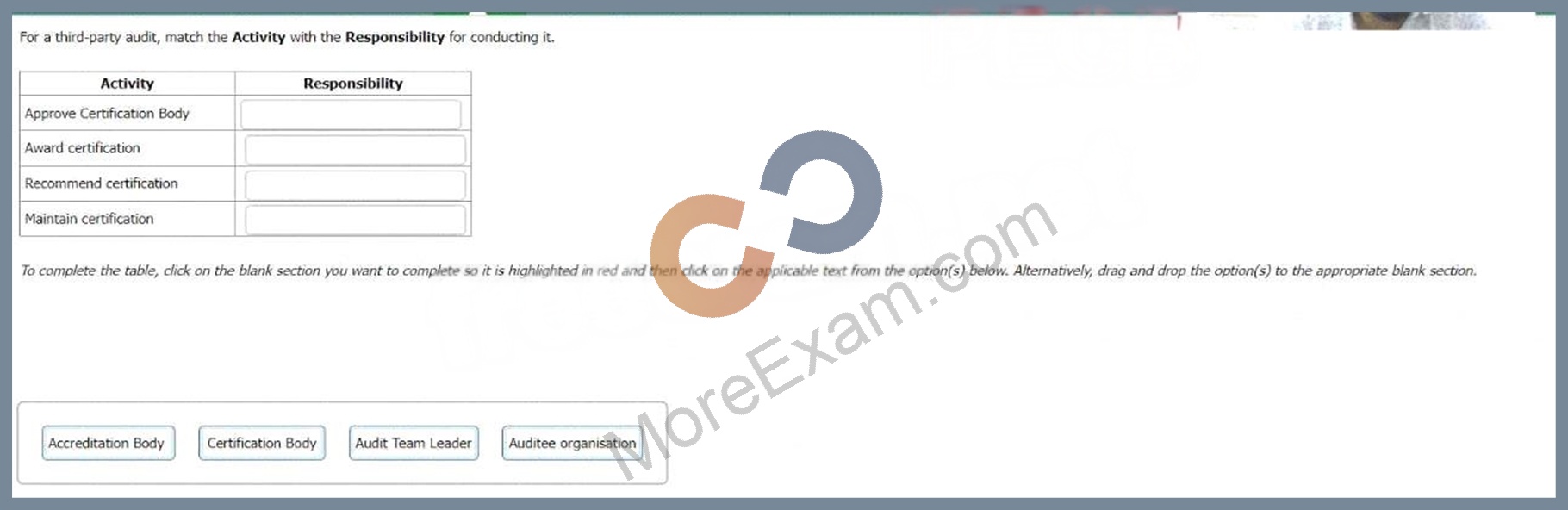
Question31: TIX provides services to the informatic equipment of large organisations. They operate an ISO 9001:2015 QMS that is being audited by an important customer (second-party audit). During the audit, the audit team has identified two nonconformities. When preparing the Closing meeting, the audit team discussed and agreed both nonconformities with TIX's quality manager. The Closing meeting was planned for 6pm with the general manager, quality manager and service manager at the meeting room.
At 6pm, when the audit team enters the meeting room, only two people are present and waiting for them: the Health and Safety supervisor and the warehouse supervisor. Neither have participated in the audit.
The dialogue among them is as follows:
Audit team leader: "Good evening, could you please inform the three managers that we are ready to start with the Closing meeting?" Health and Safety supervisor: "Good evening. We are sorry to inform you that the general manager was involved in a serious car accident, and the other two managers have had to leave urgently to attend the emergency." Warehouse supervisor: "They have asked us to listen to what you need to say and to sign whatever we need to sign. We also have a message from them about the two nonconformities. They wanted us to ask you if you could contact them in a couple of days to determine how to proceed." Which one of the following options would be your preferred response to the final comment made by the warehouse manager?

Question32: Select which one of the following statements is true.

Question33: In the context of a management system audit, identify the sequence of a typical process for collecting and verifying information. The first one has been done for you.
To complete the sequence click on the blank section you want to complete so it is highlighted in red and then click on the applicable text from the options below. Alternatively, drag and drop the options to the appropriate blank section.

Question34: In the context of a third-party certification audit, it is very important to have effective communication. Which is not the responsibility of the audit team leader?

Question35: You are carrying out an audit at a single-site organisation seeking certification to ISO 9001 for the first time.
The
organisation manufactures cosmetics for major retailers and the name of the retailer supplied appears on the product packaging. Sales turnover has increased significantly over the past five years. The organisation uses a software programme called SWIFT, which is used to record sales, plan production, purchase supplies, print despatch notes, track new product development, perform traceability exercises, carry out mass balance checks, raise invoices, create budgets, and support financial control.
You are nearing the end of the audit and you are reviewing your audit notes. You notice a recurring trend concerning the SWIFT database as shown below:

You ask the Quality Manager to explain how the SWIFT database is controlled. You learn that the Operations Director is responsible for determining and progressing SWIFT software updates. You decide to meet the Operations Director (OD).
You: "Good afternoon."
OD: "Good afternoon."
You: "What responsibility do you have concerning the SWIFT database?"
OD: "I maintain it. If anyone wishes to propose an update to the database, they send me an email with details of their proposal. I then either process the database update myself, or I send the request to the consultant who designed the database 20 years ago. The necessary software changes are made, and the amended software is immediately released to users." You: "Would you explain how the software amendments are controlled?" OD: "Of course. I personally update every computer myself." You: "Do you inform the database users of the changes?" OD: "No I don't. They find out for themselves by using the software, or they come to see me if they have any questions." You: "How do you ensure that the database users use the latest version?" OD: "That's easy, I update every computer myself." You: "During the audit, I noted there were several versions of SWIFT in use (you refer to your audit notes)." OD: "I know. That's because some versions work better than others, and depending on user needs and experiences, we allow users to revert to using an earlier version if they find it works better for them." Based on the scenario, which two of the following statements are true? There is evidence of nonconformity with a requirement defined in ...

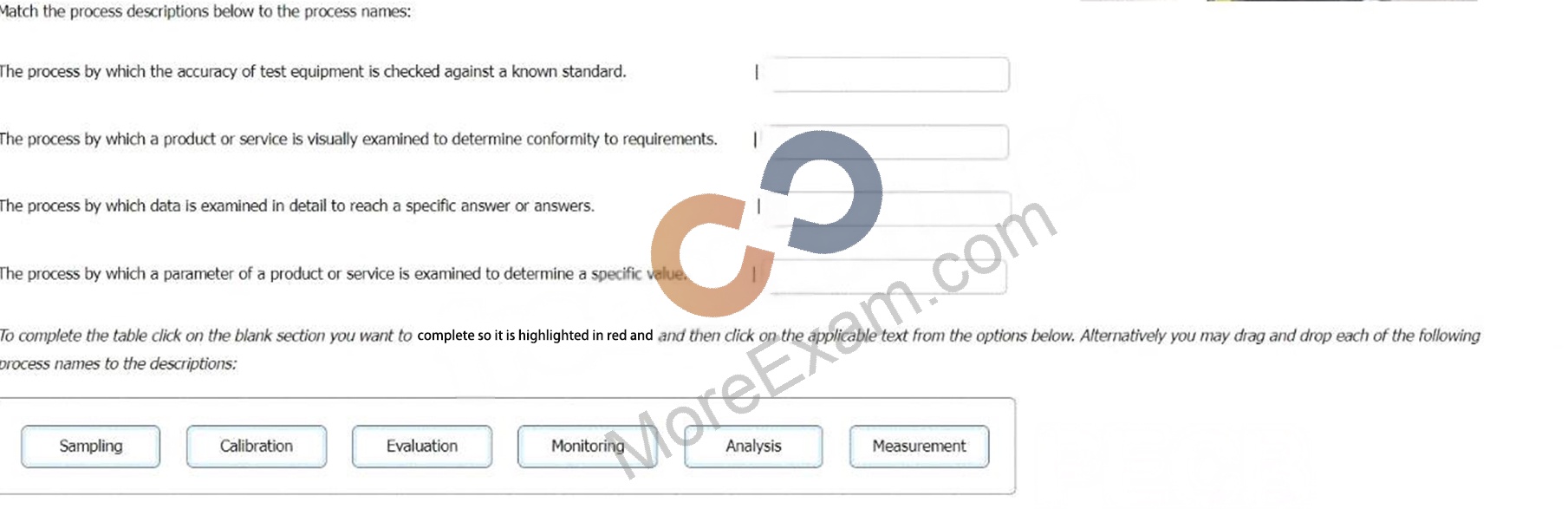
Question36: Match the process descriptions below to the process names: